
Bottom line: Ready. Set. Food! Stage 1 is the best overall pick — a 30-day guided system that introduces peanut, egg, and milk one at a time, following the same protocol used in clinical trials. For budget-conscious families with babies already on solids, Lil Mixins Daily Mix covers 7 allergens in one affordable daily scoop.
If your pediatrician recently told you to start introducing allergens early, you’re probably feeling a mix of relief and overwhelm. Relief because the science is clear — early introduction works. Overwhelm because figuring out how to safely introduce peanuts, eggs, tree nuts, and seven other common allergens to a 4-to-6-month-old feels like a lot. That’s exactly what allergen introduction kits solve.
Important: If your baby has moderate-to-severe eczema or a suspected food allergy, consult a board-certified allergist before beginning allergen introduction at home. Also consider reviewing our guide to the best air purifiers for baby rooms — reducing airborne triggers matters especially for eczema-prone babies. Kits on this list are designed for lower-risk babies following standard guidelines.
- Quick Comparison: All 5 Kits
- Why Early Allergen Introduction Matters
- 1. Ready. Set. Food! Stage 1 — Best Overall
- 2. Lil Mixins Daily Mix — Best Budget Pick
- 3. Ready. Set. Food! Stage 3 — Best for Full Coverage
- 4. Ready. Set. Food! Organic Puffs — Best for 8+ Months
- 5. Lil Mixins Baked Egg, Tree Nut & Peanut — Best Targeted Option
- How to Choose
- Brand-by-Brand Comparisons
- Frequently Asked Questions
Quick Comparison: Best Baby Allergen Introduction Kits
| # | Kit | Best For | Allergens | Age | Shop |
|---|---|---|---|---|---|
| 1 | Ready. Set. Food! Stage 1 | Best overall — guided 30-day system | 3 (peanut, egg, milk) | 4+ mo | View on Amazon |
| 2 | Lil Mixins Daily Mix | Best budget — 7 allergens in one scoop | 7 allergens | 6+ mo | View on Amazon |
| 3 | Ready. Set. Food! Stage 3 | Best for full 9-allergen coverage | 9 allergens | 4+ mo | View on Amazon |
| 4 | Mission MightyMe Nutty Puffs | Best snack format — 9 allergens, 8+ months | 9 allergens | 8+ mo | View on Amazon |
| 5 | Lil Mixins Baked Egg, Tree Nut & Peanut | Best targeted — highest-risk allergens only | 3 targeted | 6+ mo | View on Amazon |
Why Early Allergen Introduction Matters
The science here is settled. The landmark LEAP study showed that babies at high risk for peanut allergy who were given peanuts early had an 81% reduction in peanut allergy compared to those who avoided it. The AAP and NIAID now both recommend introducing allergenic foods starting around 4–6 months. The question isn’t whether to introduce — it’s how.
What we did: We started allergen introduction at 5 months using Ready. Set. Food! Stage 1. The day-labeled packets removed every guessing game — we never had to wonder whether we’d given the right dose or skipped a day.
1. Ready. Set. Food! Stage 1 Mix-Ins — Best Overall
Stage 1 Mix-Ins — Best for babies 4+ months, not yet on solids
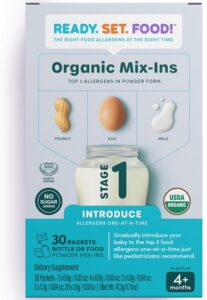
Ready. Set. Food! Stage 1 is a 30-day guided program. Each pre-measured packet is labeled Day 1 through Day 30 and introduces peanut, egg, and milk — one at a time — before slowly increasing to the maintenance amount used in clinical studies. Mix the powder into breastmilk, formula, or baby food. No measuring, no prep, no guessing about dose.
How It Works: Daily pre-measured packets, Day 1–30 labeled. Introduces one allergen at a time at increasing doses following clinical trial protocols.
Why It Stands Out: Research-based staged system. Clean organic ingredients. Dissolves completely into breastmilk or formula — our baby never noticed it.
Honest Limitation: More expensive than loose powders. Stage 1 only covers 3 allergens — you’ll move to Stage 3 for full coverage.
Best for: Families starting allergen introduction before solids begin, or anyone who wants maximum hand-holding through the process.
2. Lil Mixins Daily Mix — Best Budget Pick
Daily Mix — Best for babies 6+ months on solids
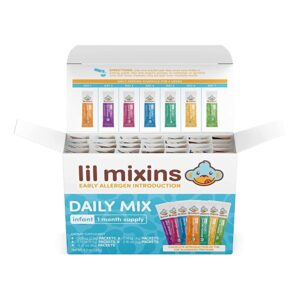
Lil Mixins covers 7 top allergens in one daily scoop — peanut, egg, milk, wheat, soy, tree nuts, and sesame. Mix into oatmeal, puree, or any food your baby already eats. It’s meaningfully cheaper per month than Ready. Set. Food! and works well as a maintenance product once individual allergens have been safely introduced.
How It Works: One scoop per day stirred into solid food. All 7 allergens in every dose at clinically studied amounts.
Why It Stands Out: Lowest monthly cost on this list. No flavor impact in our testing — disappeared completely into oatmeal.
Honest Limitation: Not a staged system — all allergens introduced simultaneously. If a reaction occurs, identifying which allergen caused it is harder. Best for lower-risk babies.
Best for: Budget-conscious families whose baby has no elevated risk factors and whose pediatrician has cleared simultaneous introduction.
3. Ready. Set. Food! Stage 3 Mix-Ins — Best for Full 9-Allergen Coverage
Stage 3 Mix-Ins — Best after Stage 1 is complete
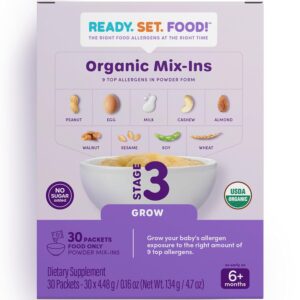
Stage 3 expands to all 9 top allergens — continuing peanut, egg, and milk while adding cashew, almond, walnut, sesame, soy, and wheat. Together these cover approximately 90% of all food allergies that develop in children. We moved straight to Stage 3 after completing Stage 1 and found the transition seamless.
How It Works: Same pre-measured daily packet format as Stage 1, now covering all 9 allergens at maintenance doses.
Best for: Families who have completed Stage 1 and want to expand to full allergen coverage in the same trusted format.
4. Mission MightyMe Nutty Puffs — Best Snack Format for 8+ Months
Organic Puffs — Best snack-format maintenance option

Once your baby is past the puree stage, maintaining allergen exposure through powder mix-ins can feel repetitive. Puffs turn maintenance into snack time — each serving contains all 9 allergens at the clinically studied dose. They’re USDA organic, dissolve easily, and are sized for babies 8+ months with pincer grip developing.
How It Works: Regular puff snack format with 9 allergens baked in. One serving = maintenance dose. No mixing required.
Honest Limitation: Only appropriate once individual allergens have been cleared through a proper introduction protocol. Don’t use as a first introduction vehicle.
Best for: Parents of babies 8+ months who want a convenient way to maintain allergen exposure beyond the powder stage.
5. Lil Mixins Baked Egg, Tree Nut & Peanut — Best Targeted Option
Baked Egg, Tree Nut & Peanut Mix-Ins — Best for targeted high-risk allergen coverage
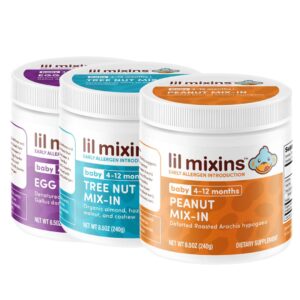
Some families don’t need a full multi-allergen system — they just need to target the highest-risk allergens specifically. This formula concentrates on baked egg, tree nuts (cashew, walnut, almond), and peanut — the three allergens associated with the most severe reactions. Same clean no-filler formula as the Daily Mix, one scoop into any food daily.
How It Works: One scoop daily into solid food. Focused on the 3 allergen groups most associated with severe anaphylaxis.
Best for: Families with a specific family history of egg, nut, or peanut allergy who want targeted coverage without the full multi-allergen system.
How to Choose the Right Allergen Introduction Kit for Your Baby
Does your baby have eczema or a family history of allergies? Go with Ready. Set. Food!’s staged system — introducing one allergen at a time makes it much easier to identify what caused a reaction if one occurs.
How old is your baby? Under 6 months and not yet on solids: Ready. Set. Food! Stage 1 (dissolves into breastmilk or formula). Over 6 months on solids: any kit on this list works, including the more affordable Lil Mixins.
Do you want a system or a supplement? Ready. Set. Food! gives you a day-by-day guided system. Lil Mixins is a daily supplement you add to your existing feeding routine. Both work — it depends on whether you want hand-holding or simplicity.
What’s your budget? Lil Mixins is the most affordable monthly option. Ready. Set. Food! costs more but the staged format and guidance is worth it for higher-risk babies or parents who want more structure.
Brand-by-Brand Comparisons
Ready. Set. Food! vs. Lil Mixins: Which Is Right for Your Baby?
Ready. Set. Food! is a liquid drop system designed to dissolve into breastmilk or formula — ideal for babies as young as 4 months not yet on solids. Lil Mixins is a powder best stirred into solid foods, making it the better fit from 6 months. On allergen coverage, Ready. Set. Food! Stage 3 covers 9 allergens; Lil Mixins Daily Mix covers 7. On price, Lil Mixins is meaningfully cheaper per month. If your baby has elevated risk or isn’t on solids yet, Ready. Set. Food!’s staged system is worth the premium. If your baby is already eating solids and you want affordable daily coverage, Lil Mixins wins on value.
SpoonfulOne vs. Ready. Set. Food!
SpoonfulOne covers 16 allergens in a single daily dose — broader than Ready. Set. Food!’s staged approach, but without the one-at-a-time introduction structure. For families cleared for simultaneous introduction, SpoonfulOne offers the widest allergen coverage on the market. For families who want a staged, guided system — especially with any elevated risk — Ready. Set. Food!’s clinical-trial-based protocol is the stronger choice. We used Ready. Set. Food! for the staged introduction, then considered SpoonfulOne for maintenance once each allergen was cleared.
Frequently Asked Questions
When should I start introducing allergens to my baby?
Current AAP and NIAID guidelines recommend starting allergen introduction around 4–6 months, when your baby shows signs of developmental readiness for solids. Babies with moderate-to-severe eczema or a suspected egg allergy should be evaluated by an allergist first before starting at home.
Are these kits safe to use at home?
For low-risk babies, yes — these kits are specifically designed for home use following clinical protocols. If your baby has significant eczema, a suspected existing food allergy, or a family history of anaphylaxis, always consult your pediatrician or allergist before starting.
Do I have to buy a kit, or can I just use regular peanut butter?
You can use whole foods — smooth peanut butter thinned with water, scrambled egg, etc. Kits make it easier by providing pre-measured doses and covering multiple allergens consistently. For the exact dosing schedule when using loose peanut powder, see our peanut powder dosing guide.
How long do I need to keep introducing allergens?
A one-time introduction is not enough. Ready. Set. Food! recommends continuing for at least 6 months, or until your baby is regularly eating allergens at least 3 times per week. The goal is regular ongoing exposure, not a single introduction event.
Is Ready. Set. Food! worth the price over Lil Mixins?
It depends on what you’re paying for. Ready. Set. Food! offers a structured staged system with clear guidance — worth it if you want hand-holding or if your baby has any elevated risk. Lil Mixins is a simpler, more affordable daily supplement covering 7 allergens in one product — the better fit for lower-risk families who want convenient daily coverage without the system overhead.
The Bottom Line
For most families, Ready. Set. Food! Stage 1 is the right starting point — it follows the clinical trial protocol, removes all guesswork, and the day-labeled packets make it almost impossible to skip a dose accidentally. Once Stage 1 is complete, move to Stage 3 to expand to all 9 allergens. If budget is the primary concern and your baby is already on solids with no elevated risk, Lil Mixins Daily Mix delivers solid multi-allergen coverage at a meaningfully lower monthly cost.
Always follow your pediatrician’s specific recommendation for your child before beginning allergen introduction at home.