If your baby has eczema, you’ve probably heard that an air purifier might help. You’ve also probably spent enough on creams and ointments that you’re skeptical of anything that sounds like another thing to buy.
Here’s the honest answer: an air purifier can genuinely help — but only as one part of a broader environmental strategy, and only if you understand what it does and doesn’t do. A purifier running in a room full of dust-mite-laden carpet and unencased mattresses won’t move the needle much on your baby’s skin.
This guide covers what the evidence actually says, what else needs to happen alongside the purifier, and which specific models are worth using in a nursery. Whether you’re choosing an air purifier for infants or an air purifier for a newborn’s room, these are the five we’d consider.
Always consult your pediatrician or allergist before making significant changes to your baby’s environment, especially if they have severe eczema or a known allergy diagnosis.
Quick picks
| # | Purifier | Why we like it |
|---|---|---|
| 1 | Levoit Core 300S | Best overall. Whisper-quiet at 22dB, True HEPA, app-controlled. Best balance of quiet, filtration, and smart features. |
| 2 | Coway Airmega 150 | Best compact. Zero ozone, proven brand, excellent for smaller rooms up to 237 sq ft. |
| 3 | Blueair Blue Pure 311i Max | Best design. Stylish, near-silent, washable pre-filter. Great for style-conscious nurseries. |
| 4 | GermGuardian AC4825E | Best for germ-prone homes. UV-C + HEPA — ideal when older siblings bring home daycare bugs. |
| 5 | Winix 5510 | Best for larger rooms. Covers bigger nurseries or shared spaces up to 360 sq ft. |
Why air quality matters specifically for eczema babies
Eczema isn’t just a skin condition — it’s an immune system condition. Babies with eczema have a compromised skin barrier, which means airborne particles that settle on the skin can penetrate more easily and trigger inflammatory responses. The most common culprits are dust mite proteins, pet dander, mold spores, and pollen.
The connection between eczema and airborne triggers is well established. Dust mite allergy in particular is one of the most significant environmental triggers — and dust mite proteins are light enough to become airborne whenever you disturb bedding, carpets, or upholstered furniture. Your baby breathing those particles in and having them land on already-inflamed skin creates a feedback loop that no cream alone will break.
This is also why, if you’re working on early allergen introduction for a baby with eczema, environmental management matters even more. The skin barrier is your baby’s first line of immune defense — keeping airborne irritants low while you’re doing introduction gives that barrier a better chance to do its job. (See our guide to the 5 Best Baby Allergen Introduction Kits for why early introduction is especially important for eczema-prone babies.)
What an air purifier actually does (and doesn’t do)
What it does: A True HEPA air purifier continuously captures airborne particles — dust mite proteins, pet dander, pollen, mold spores, and fine particulate matter — before they can settle on surfaces or your baby’s skin. Run consistently in the nursery, it meaningfully reduces the concentration of airborne triggers.
What it doesn’t do: It cannot reach the dust mites living inside your baby’s mattress, inside pillows, or deep in carpet fibers. Those mites aren’t airborne — they’re embedded. An air purifier running 24/7 won’t help much if your baby is sleeping on an unencased mattress full of mite allergens. This is the mistake most parents make: buying a purifier and expecting it to solve everything, without addressing the source.
The practical implication: an air purifier is most effective as the last line of defense after you’ve already reduced the source load through the other steps below.
The full environmental strategy (in priority order)
These are the steps evidence supports for reducing eczema triggers in a baby’s room, in rough order of impact:
1. Encase the mattress and pillow
Dust mite-proof covers go over the mattress and any pillow, zipping closed to trap mites inside and block new ones. This is the single highest-impact intervention for dust mite-triggered eczema. Look for covers rated to block particles under 10 microns.
2. Wash bedding weekly in hot water
Dust mites die at 130°F (54°C). Washing crib sheets, blankets, and any stuffed animals your baby sleeps with weekly at this temperature kills mites and removes their droppings. Cold-water washing does not kill mites.
3. Control humidity
Dust mites thrive in humidity above 50%. Keeping your home between 45–50% relative humidity significantly reduces the mite population over time. A hygrometer (under $15) lets you monitor this. In humid climates, a dehumidifier in the nursery may be more impactful than an air purifier.
4. Hard floors over carpet where possible
Carpet is a reservoir for dust mites, pet dander, and mold. If you have carpet in the nursery, vacuum twice weekly with a HEPA-filter vacuum. Hard floors are meaningfully easier to keep low-allergen.
5. Add the air purifier
With the above in place, a True HEPA purifier captures what’s still becoming airborne — from bedding movement, from adjacent rooms, from windows — and keeps the airborne load consistently low. At this point it genuinely helps. Without the above steps, it’s doing less than you think.
What to look for in a purifier for an eczema baby’s room
True HEPA only — not “HEPA-type” or “HEPA-like.” True HEPA captures 99.97% of particles at 0.3 microns. Dust mite allergens and pet dander fall in this range. The American Lung Association recommends HEPA filtration for reducing indoor airborne allergens. Non-negotiable.
No ozone — avoid ionizers as the primary technology. Ozone irritates infant airways and can worsen respiratory symptoms that often accompany eczema. If a unit includes UV-C, confirm it’s fully sealed inside the housing.
Activated carbon filter — helpful for VOCs from new furniture, paint, and cleaning products, which are also known eczema irritants. Most quality units include this alongside the HEPA filter.
Quiet on low — under 30dB. You’ll run this 24/7 on the lowest setting. Anything louder disrupts sleep.
CADR matched to room size — for a standard nursery (150–250 sq ft), aim for at least 100 CFM. Don’t push it into a corner — it needs to draw air from multiple directions.
No bright display lights — look for models with a display-off or sleep mode. Any glow will disrupt your baby’s sleep.
Full reviews: air purifiers for infants and newborns
1. Levoit Core 300S — Best overall
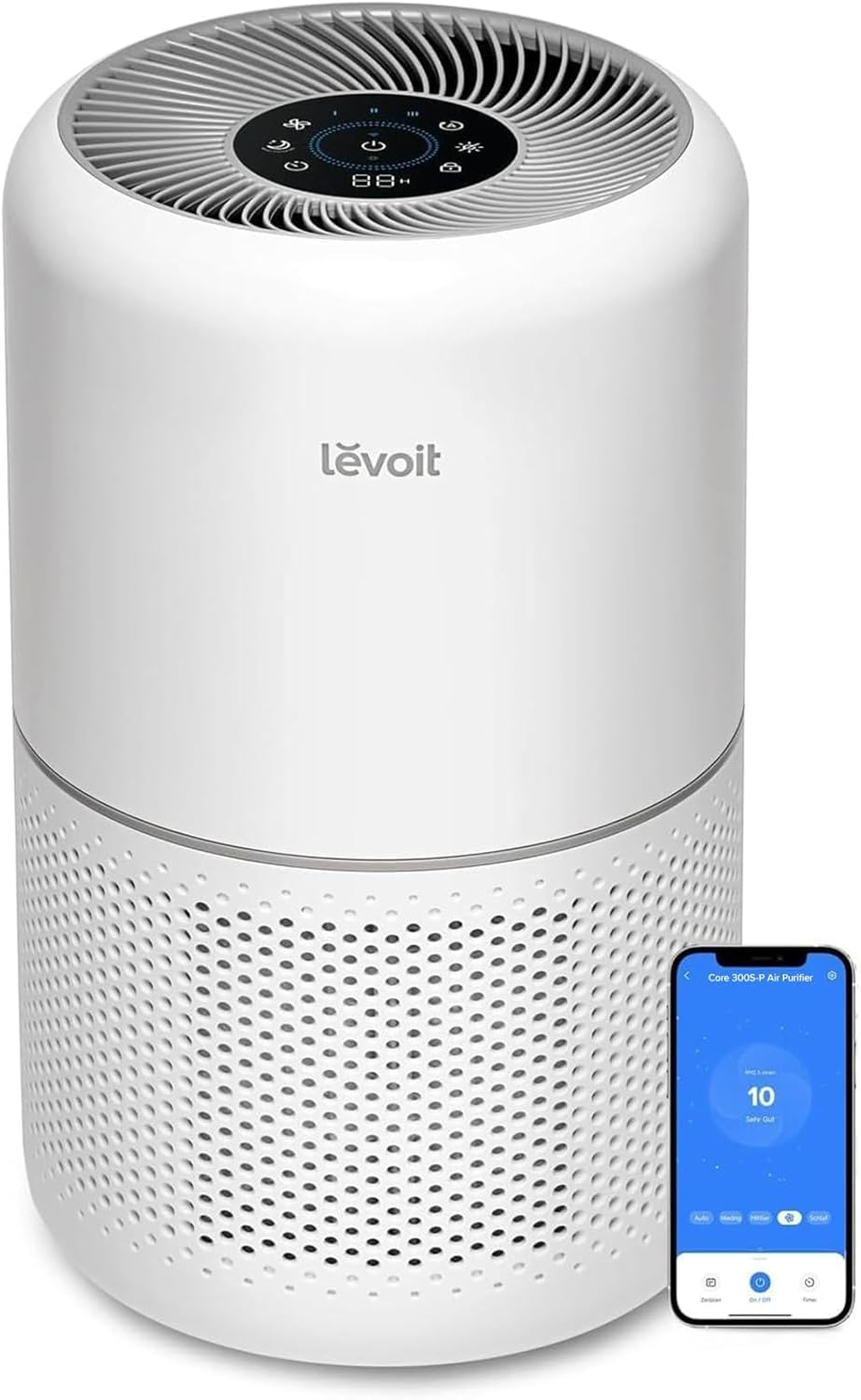
The Core 300S is the most practical choice for most nurseries. It runs at 22dB on sleep mode — quieter than a whisper — the display fully shuts off, and True HEPA captures particles down to 0.1 microns. The VeSync app lets you adjust settings without entering the room, and the app-based child lock is useful once your baby gets mobile. Covers up to 219 sq ft.
What makes it the right choice for eczema specifically: the combination of True HEPA plus activated carbon filtration handles both particulate triggers (dust mite proteins, dander) and chemical irritants (VOCs from new nursery furniture) in one compact unit.
Best for: Most families. The best balance of quiet, filtration quality, and smart controls at a mid-range price.
2. Coway Airmega 150 — Best compact
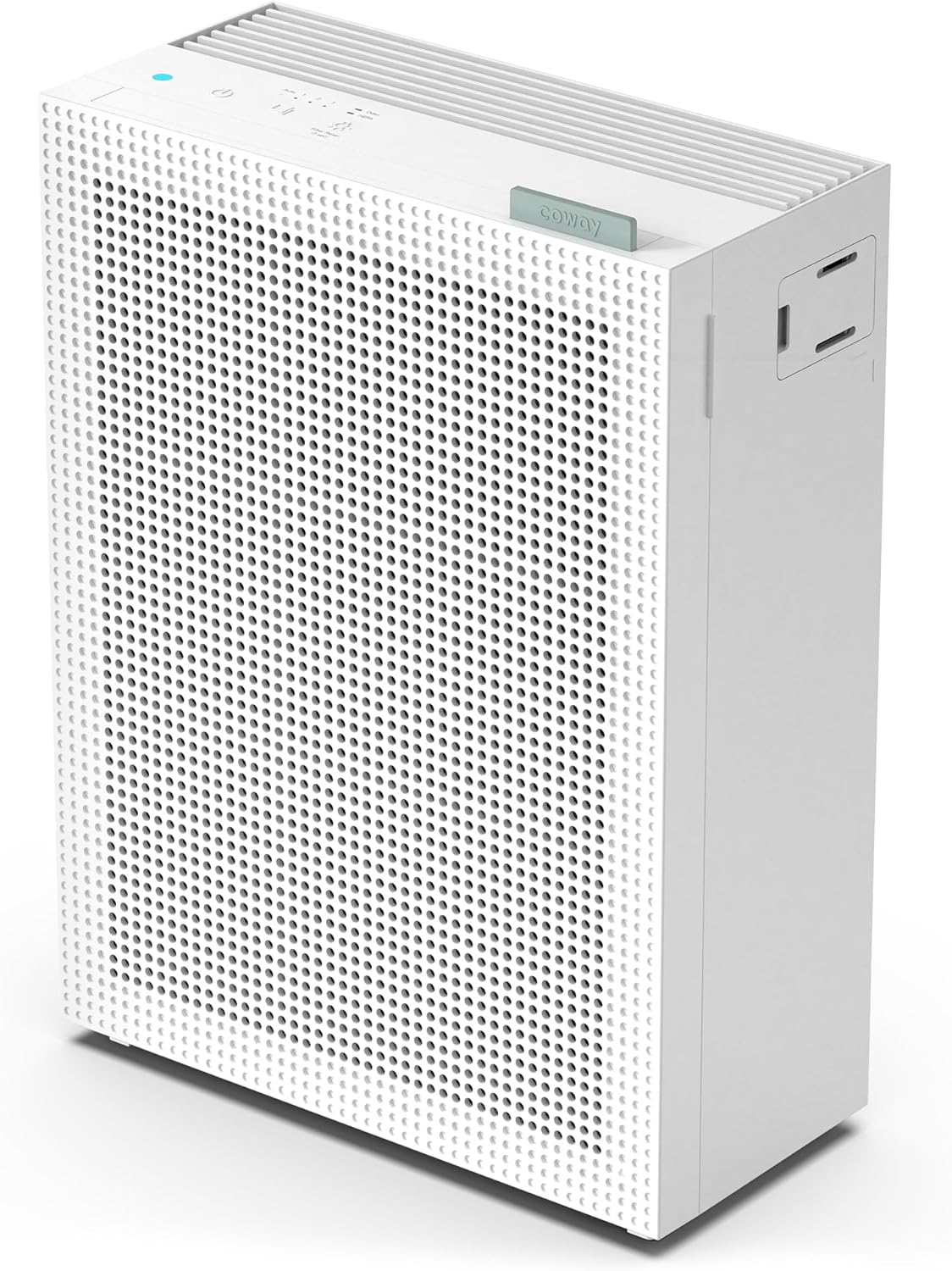
Zero ozone, completely safe for infant airways, and three-stage filtration — pre-filter, True HEPA, and activated carbon — in a compact footprint that fits on a dresser without dominating the room. Coway is one of the most consistently tested and trusted air purifier brands. Covers 237 sq ft.
Best for: Smaller nurseries, parents who want a proven brand without any smart features to manage.
3. Blueair Blue Pure 311i Max — Best design
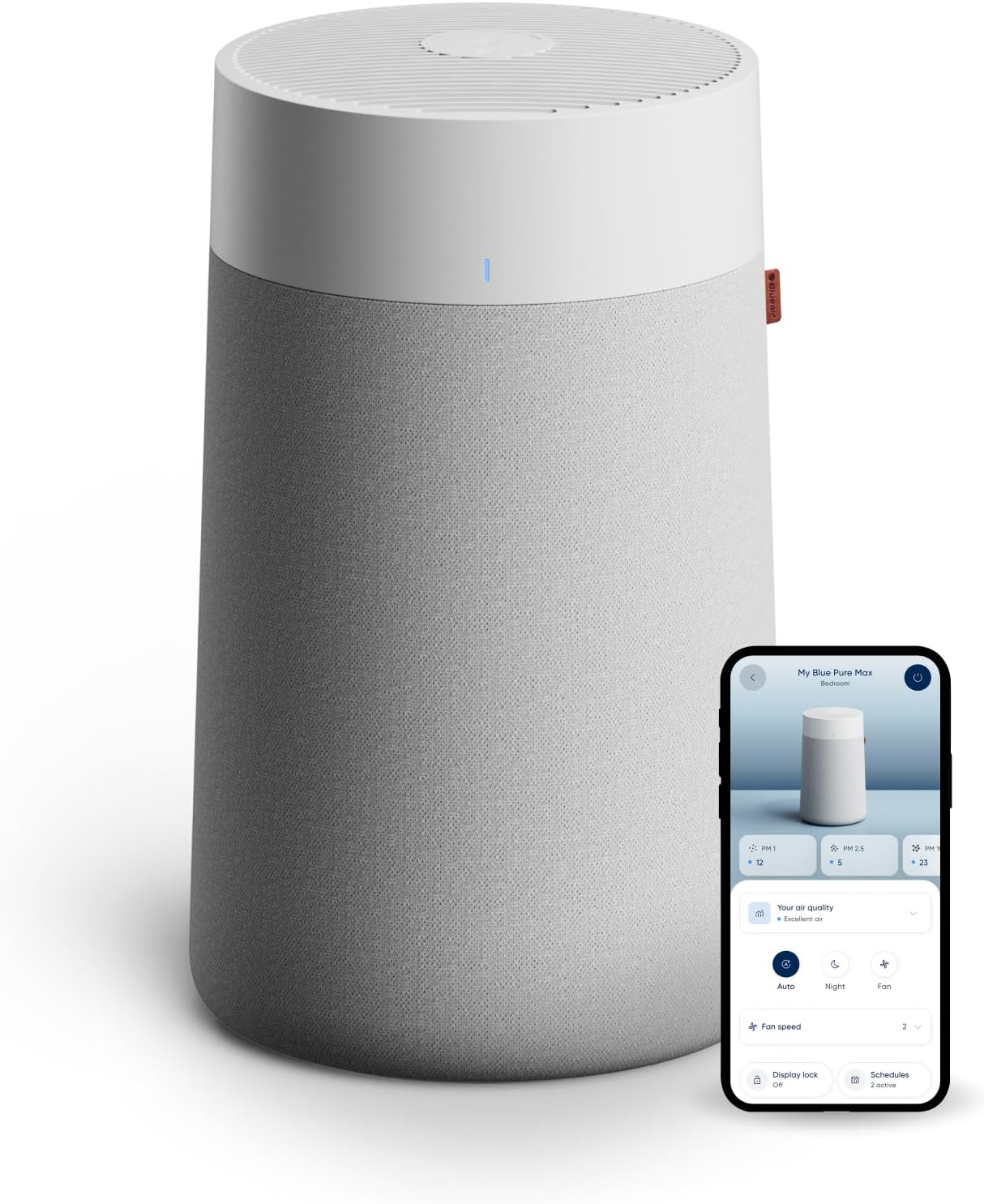
If the nursery aesthetic matters — and it often does — the Blueair 311i Max is the pick. It comes in multiple fabric pre-filter colors, has a clean cylindrical silhouette, and blends into a room rather than dominating it. The washable fabric pre-filter saves on replacement costs over time. Amazon lists it for medium rooms, so it suits a larger nursery or shared bedroom better than a tiny one: it cleans about 439 sq ft in 12.5 minutes and up to 2,107 sq ft in an hour, per Blueair’s listing. It’s a WiFi model with app control and an auto mode.
Best for: Design-conscious parents and nurseries where the purifier will be on display.
4. GermGuardian AC4825E — Best for germ-prone homes
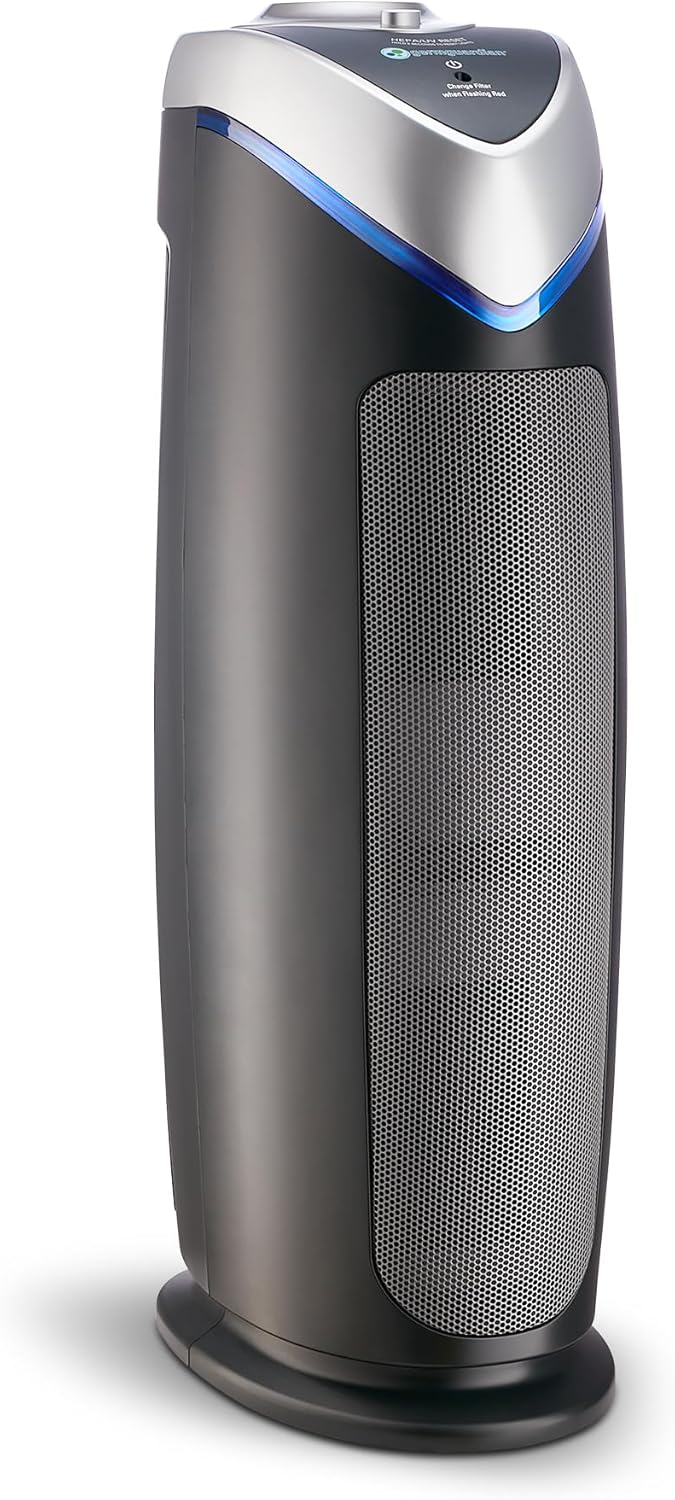
The GermGuardian adds UV-C light on top of True HEPA filtration, which neutralizes bacteria and viruses — not just particles. Especially useful in homes with older siblings in daycare or school. The UV-C is sealed inside the unit so no ozone escapes. Covers up to 743 sq ft and the tower design tucks neatly into a corner.
Best for: Homes with multiple kids, frequent illness exposure, or parents who want an extra layer of germ protection during cold and flu season.
5. Winix 5510 — Best for larger rooms
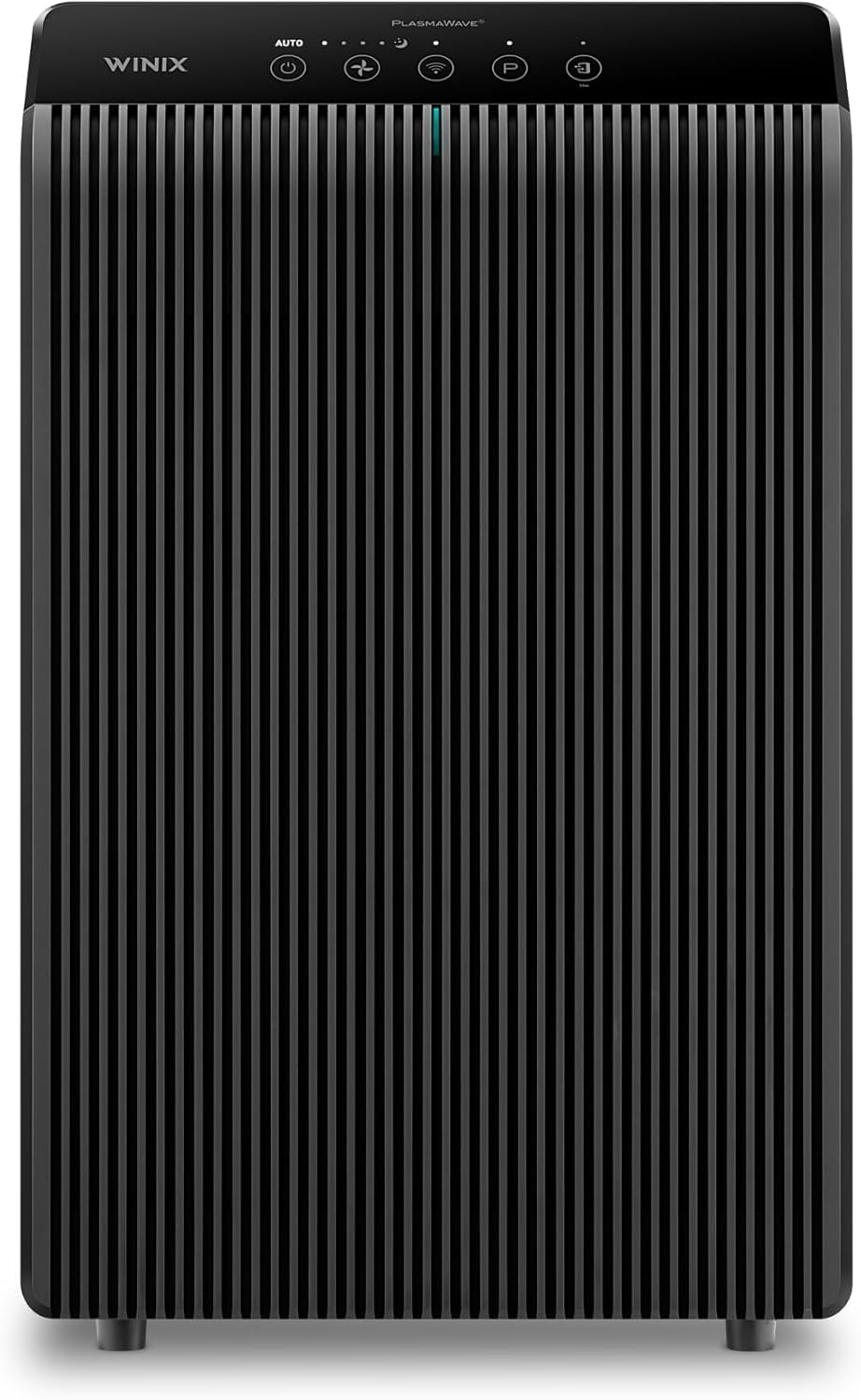
If your nursery is on the larger side, or your baby sleeps in a shared room, the Winix 5510 handles up to 360 sq ft with four-stage filtration including True HEPA. Auto mode adjusts fan speed based on real-time air quality. PlasmaWave can be switched off entirely if you prefer pure mechanical filtration.
Best for: Larger nurseries, open-plan spaces, families with pets.
Common questions
What is the best air purifier for infants and newborns?
Of the five in this guide, the Levoit Core 300S is our top overall pick for a newborn’s room, and the Coway Airmega 150 is the best compact option. See the full reviews above for how they compare.
Does running an air purifier actually reduce eczema flare-ups?
The evidence supports it as part of a comprehensive approach — not as a standalone solution. Reducing airborne allergen concentration improves eczema outcomes, particularly for dust mite and pet dander-sensitive babies. But the purifier has to be combined with the bedding and humidity interventions above to make a meaningful difference.
Where should I place it in the nursery?
At least 3 feet from the crib, on the floor or a low surface with open clearance on the sides. Don’t push it into a corner. Near the door is often effective since that’s where particles enter from adjacent rooms.
Should I run it 24/7?
Yes. Air purifiers maintain clean air continuously — they don’t just react to dirty air. Most use less electricity than a nightlight on their lowest setting.
When should I replace the filter?
Every 6–8 months for a nursery running 24/7. A clogged HEPA filter stops capturing and can start releasing particles back into the air. Don’t wait for the indicator if you’ve been running it continuously.
What about a humidifier — should I use both?
They do different things. If your nursery air is dry (under 45% humidity), a cool-mist humidifier helps keep your baby’s skin and airways from drying out. If humidity is already at 50%+, skip the humidifier — higher humidity feeds dust mites and mold. Check with a hygrometer first.
The bottom line
An air purifier is worth having in an eczema baby’s nursery — but it’s the last step in an environmental strategy, not the first. Encase the mattress, wash bedding in hot water weekly, and control humidity first. Then add a True HEPA purifier to capture what’s still airborne. In that context, it genuinely helps.
For most nurseries, the Levoit Core 300S is the right call. For smaller rooms, the Coway Airmega 150. For larger spaces or homes with pets, the Winix 5510.
Related reading
Building a healthier environment for your baby from day one? Also see our guides to the 5 Best Baby Allergen Introduction Kits — particularly important if your baby has eczema, since early introduction is especially recommended for high-risk babies — and the 4 Best Allergy Test Kits for Kids.
This post is for informational purposes only and does not constitute medical advice. Always consult your pediatrician if your baby has known respiratory conditions or severe allergies.
Affiliate disclosure: This post contains Amazon affiliate links. We may earn a small commission at no extra cost to you.