
Baby Sleep · The 4-Month Regression
It’s 2:47 a.m., you did nothing wrong, and yes, this is normal. Here’s what’s going on in that tiny brain—and what actually helps.
This post contains affiliate links. If you buy through them, I may earn a commission at no extra cost to you. As an Amazon Associate I earn from qualifying purchases. I only recommend things I’d actually put in my own house.
It’s 2:47 a.m. Your baby, who was sleeping in longer stretches last week, is awake again. You did nothing wrong. You are not being punished. You are, however, about to become very familiar with your ceiling.
Welcome to the 4-month sleep regression. Let’s talk about what’s going on and what helps.
Jump to Why it happens · Regression vs. hunger vs. overtired · Sample schedule · Sleep environment · When to call the doctor · FAQ
The 4-month sleep regression happens as your baby’s sleep matures into adult-style cycles, and they briefly wake at the end of each one (about every 45 minutes). The change itself is permanent, but the rough patch is temporary—and age-appropriate wake windows, a dark room, and practicing drowsy-but-awake help them connect cycles.
| What it does | Our pick | Why we like it |
|---|---|---|
| Tracking and personalized schedules | Huckleberry Pro | Wake windows and naps tailored to your baby |
| Sound masking | Hatch Rest 2nd Gen | Masks household noise and builds a routine |
| Room darkening | NICETOWN Blackout Curtains | Blocks light for longer naps |
| Portable darkening | Tommee Tippee (Gro Anywhere) Portable Blackout Blind | Darkens any room, travel-friendly |
| Safe, cozy bedding | Halo SleepSack Wearable Blanket | Wearable blanket, no loose bedding |
| Room temperature check | ThermoPro TP50 Thermometer/Hygrometer | Easy-to-read temperature at a glance |
Why Your 4-Month-Old Wakes Every 45 Minutes (The 4-Month Sleep Regression)
Around 3 to 5 months, your baby’s sleep matures. Newborns sleep in a pretty simple pattern. At this age, their sleep starts to look more like ours, with lighter and deeper stages and a cycle that runs roughly 45 minutes.
The problem is that at the end of each cycle, they surface into light sleep. Adults roll over and go back under without noticing. Your baby has not learned this skill yet. They wake up, look around, and file a complaint.
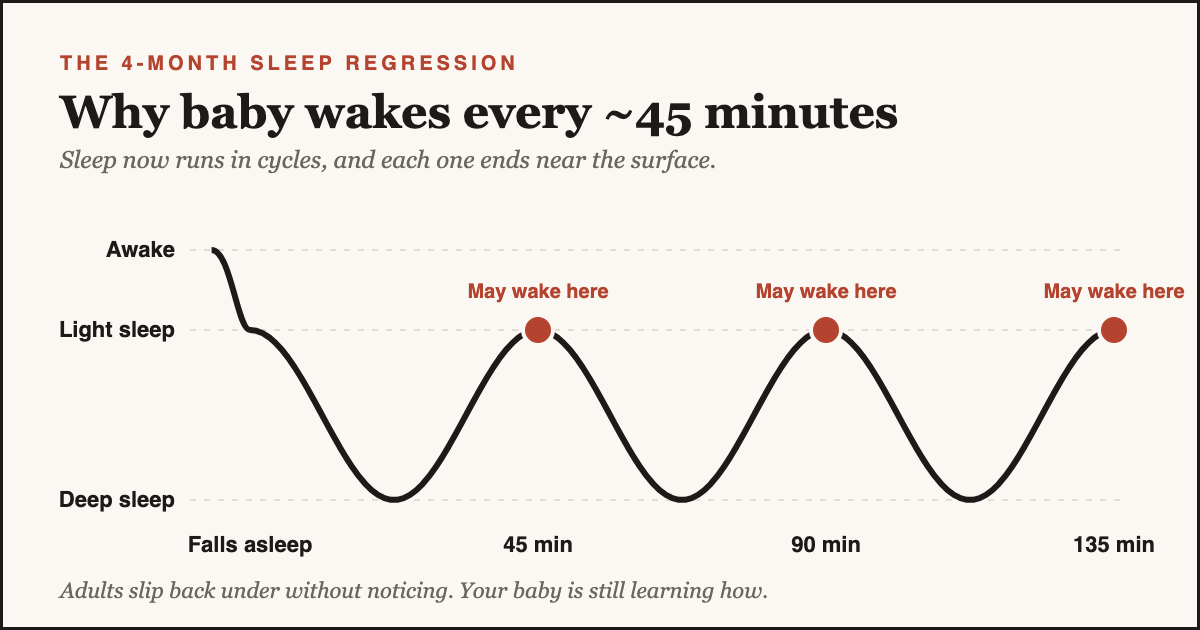
“Temporary” can mean a few weeks, and those weeks feel like a decade.
The good news is that this is a developmental change, not a setback. The maturing sleep is here to stay, but the frequent wakings usually settle as your baby learns to link cycles. The bad news is that “usually settle” takes a while.
Regression, Hunger, or Overtired?
Before you blame the regression, rule out the usual suspects.
- RegressionSleep was going okay, then suddenly fell apart. Baby is otherwise healthy and eating normally, and wakes at cycle changes (about every 45 minutes to 2 hours).
- HungerBaby is feeding a lot during the day, wakes hungry, and feeds well at night. Growth spurts are real, and so is a baby who was distracted by everything during daytime feeds.
- OvertiredBaby fights naps, wakes early, and is frantic at bedtime. Counterintuitively, an overtired baby sleeps worse, not better.
If you can’t tell which one you’re dealing with, track it for a few days. Wake times, feeds, and naps in one place make patterns show up fast. I use Huckleberry Pro for this. You log your baby’s sleep and it starts to notice what you’re too tired to notice yourself. I’d be tracking this anyway, because my memory at 3 a.m. is unreliable at best. Not sure which plan you need? Here’s our Huckleberry Plus vs. Premium breakdown.
Track it with Huckleberry Pro
Personalized wake windows and nap schedules based on your baby’s actual sleep—not a generic chart.
See if there’s a current free trial or discount →4-Month Sleep Regression Wake Windows & Sample Schedule
During the 4-month sleep regression, most babies can handle roughly 1.5 to 2.5 hours awake between sleeps, with 3 to 4 naps a day. Every baby is different, so treat these as a starting point, not a rulebook.
A sample day during the 4-month sleep regression
- 7:00 a.m.Wake
- 8:45 a.m.Nap 1
- 11:15 a.m.Nap 2
- 2:00 p.m.Nap 3
- 4:30 p.m.Short catnap (if needed)
- 7:00 p.m.Bedtime routine, then bed
Too much awake time and your baby gets overtired. Too little and they aren’t tired enough to sleep. Finding the sweet spot is the whole game, and it’s the part where Huckleberry’s personalized schedule earns its keep. It adjusts to your baby instead of a generic chart.
How to Handle 45-Minute Night Wakings: Gentle Strategies That Help
You don’t need to sleep train at 4 months, and you don’t need to do anything drastic to get through the 4-month sleep regression. These are low-effort and low-drama.
Practice drowsy-but-awake. Put your baby down when they’re sleepy but not fully out. It will fail some of the time. Try again anyway, because this is a skill they’re building.
Keep a consistent wind-down. Bath, pajamas, feed, book, song, bed. It doesn’t need to be Instagram-worthy. It needs to be the same every night. Babies love predictability the way I love a hot coffee.
Set up the room
A long-time nursery favorite, loved for the heavy, light-blocking fabric. Hang them on a rod that sits a few inches out from the window to cut the light leaks around the edges.
Check price on Amazon →For travel, grandma’s house, or rentals. It sticks to the window with suction cups and folds into a travel bag.
Check price on Amazon →One of the most popular sound machines out there, with adjustable volume, a dim nightlight, and app scheduling. It drowns out the dishwasher, the dog, and your partner’s suspiciously loud footsteps. Keep the volume low (think shower-level or quieter) and place it across the room, not in the crib. Heads up: it’s app-based and works best with Wi-Fi, and some parents mention paid extras for certain sounds.
Check price on Amazon →A top pick from several parent-tested roundups, with an easy inverted zipper for 2 a.m. diaper changes. It replaces loose blankets, which are not safe for babies. If your baby is showing signs of rolling, it’s time to stop swaddling, and a wearable blanket is a good next step. Skip anything weighted.
Check price on Amazon →Inexpensive, easy to read, and well reviewed. Many pediatric sources suggest keeping the room around 68 to 72°F, so you’re not guessing and layering on a hunch. Running an air purifier too? See our picks for the quietest air purifiers for a baby’s room so a loud fan doesn’t undo your white noise work.
Check price on Amazon →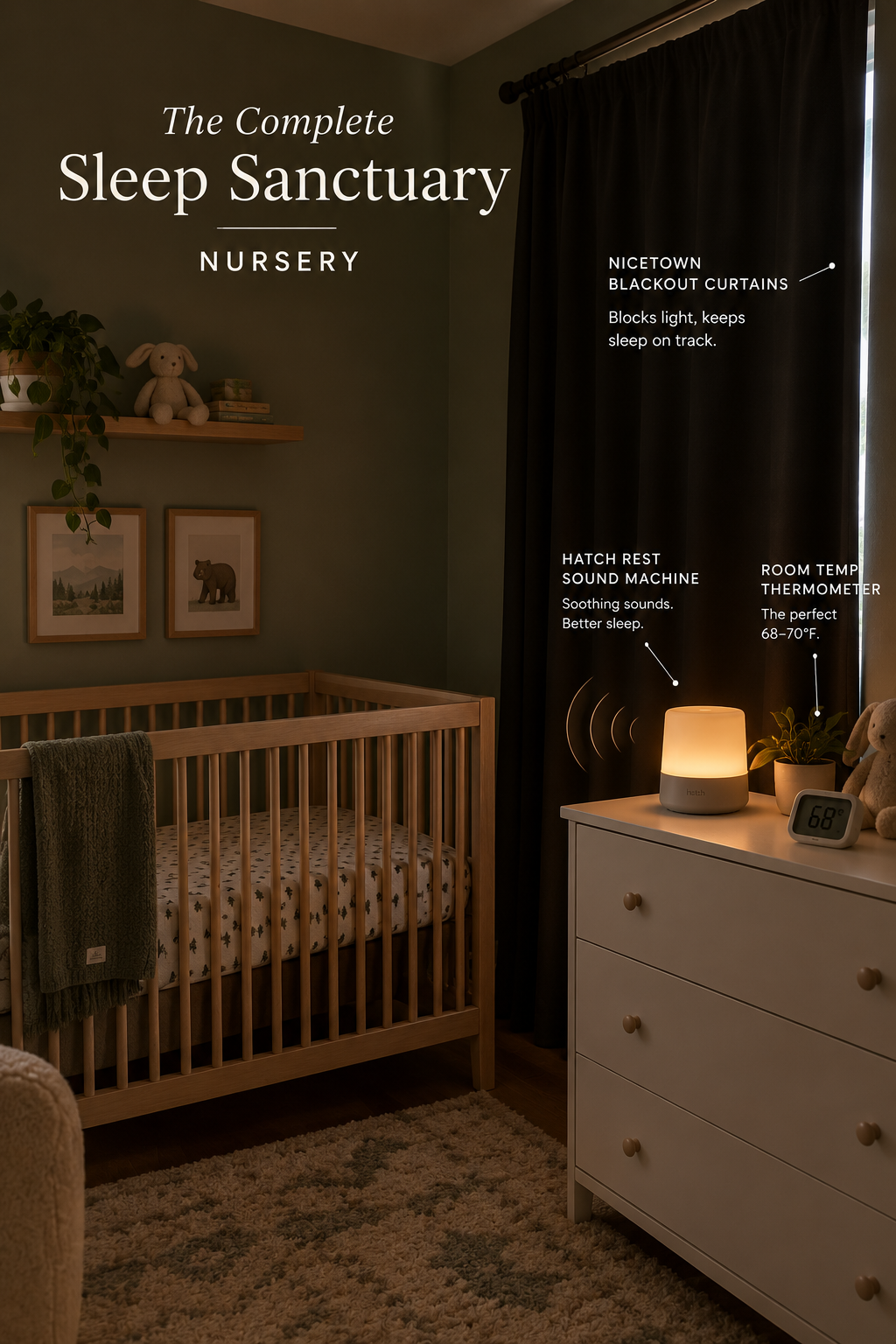
A firm, flat sleep surface, on the back, with a bare crib. No bumpers, pillows, loose blankets, or positioners. If a product promises to fix sleep by changing how your baby lies or is held, skip it. Read the AAP’s full safe sleep guidelines on HealthyChildren.org.
When to Call the Pediatrician
Wakings during the 4-month sleep regression are annoying but normal. Call your pediatrician if your baby has a fever, is feeding poorly, has trouble breathing, seems unusually lethargic, or if something just feels off. You know your baby, and “something feels off” is a good enough reason to call.
The Bottom Line
The 4-month sleep regression is not a sign that you broke your baby. It’s proof that their brain is growing. It’s also a phase, and phases end, even the ones that make you google “how long until I sleep again” at 3 a.m.
In the meantime: keep the schedule reasonable, set up the room, and lower your standards for everything else. The laundry can wait. So can the dishes. You’re doing great, even if you’re doing it on four hours of broken sleep and a cold coffee.
4-Month Sleep Regression FAQ
How long does the 4-month sleep regression last?
Often two to six weeks, though it varies from baby to baby. If it drags on well past that, or something seems off, mention it to your pediatrician.
Is the 4-month sleep regression permanent?
The change in how your baby sleeps is permanent, because their sleep is maturing into adult-style cycles. The stretch of frequent night wakings is the temporary part.
Why does my baby wake every 45 minutes?
Around 4 months, sleep cycles run about 45 minutes. Your baby surfaces into lighter sleep at the end of each one and hasn’t yet learned to link them together.
Should I sleep train at 4 months?
You don’t have to. Many families focus on wake windows, a steady wind-down, and a dark room first. If you’re considering sleep training, ask your pediatrician what’s right for your baby.
When should I stop swaddling?
Stop as soon as your baby shows signs of rolling. A wearable blanket is a good next step, and the AAP recommends against swaddling once a baby can roll over.
Our Sleep Toolkit
- Huckleberry Pro — personalized schedules and sleep tracking
- NICETOWN Blackout Curtains — darker room, longer sleep
- Hatch Rest 2nd Gen — white noise and a gentle nightlight
- Halo SleepSack Wearable Blanket — safe, cozy, no loose blankets