
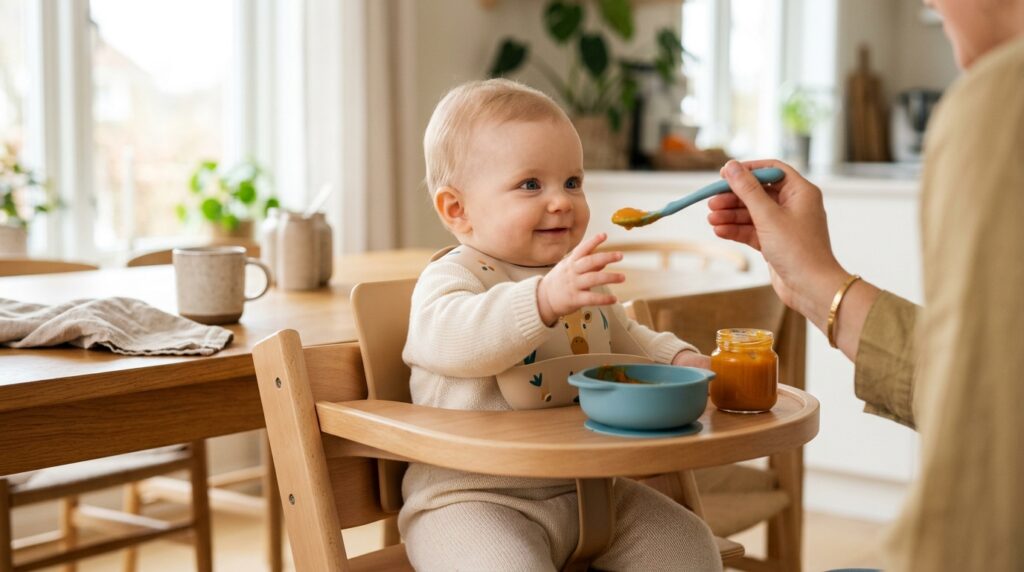
Baby Feeding · Starting Solids
Your baby is ready, your pediatrician said go, and you’re staring at a tiny spoon. Here’s what to feed first, how to handle the allergens, and which gear is actually worth buying.
This post contains affiliate links. If you buy through them, I may earn a commission at no extra cost to you. As an Amazon Associate I earn from qualifying purchases.
Your baby is eyeing your sandwich, the pediatrician has given the green light, and you are standing in the kitchen with no idea what goes on that first spoon. That’s a normal place to be, and the answer is simpler than the internet makes it sound.
This guide to starting solids at 6 months covers what to feed first, how to introduce the big allergens without panic, whether you need a special appliance (you probably don’t), and a low-effort way to keep track of what your baby has tried. It follows current pediatric guidance and is not a substitute for your own pediatrician’s advice, so if their instructions differ from anything here, go with theirs.
Jump to Is your baby ready? · First foods · Allergens · Gear · Tracking · Gagging vs. choking · FAQ
Start with single-ingredient, iron-rich foods in a smooth or very soft texture, add one new food every few days, work the common allergens in early rather than late, and use a fork, a spoon, or the blender you already own. Keep a simple running list of foods and reactions.
| What it does | Our pick | Why we like it |
|---|---|---|
| Steam and blend in one machine | Beaba Babycook Solo | Best overall in two independent tests, with consistently smooth purees |
| Budget steam and blend | NutriBullet Baby | Best value, with storage containers and a freezer tray included |
| Hands-off cooking | Baby Brezza One Step Deluxe | Easiest to use, with an automatic steam-and-blend cycle |
| Small batches in your own pot | Sage Spoonfuls Puree and Blend | An immersion blender that handled spinach where others failed |
| Travel or no-power option | OXO Tot Mash Maker Mill | Portable and manual, no outlet needed |
| Allergen introduction | Our allergen kit roundup | Kits designed to make early allergen introduction easier |
Is your baby actually ready?
The American Academy of Pediatrics recommends breast milk or formula alone until about 6 months, with readiness signs showing up somewhere between 4 and 6 months. Your pediatrician’s go-ahead is the real starting gun, but these are the signs they’re looking for (AAP / HealthyChildren.org):
- Steady head control while sitting supported and upright
- Opening the mouth when food comes toward them
- Moving food from the front of the mouth to the back to swallow (pushing it out with the tongue at first is normal, not a rejection)
- Having roughly doubled birth weight, around 13 pounds
A baby who only stares at your plate but can’t hold their head up isn’t ready yet. Wait a week or two and try again.
At first, solids are practice. Breast milk or formula is still doing most of the work.
What the first few meals look like. Think tiny. Half a spoonful or less, offered after or alongside a regular milk feed so they aren’t frustrated and hungry. Expect more food on the bib than in the baby.
What should the first foods be?
Pick single-ingredient foods, serve them smooth or very soft, and lean toward iron-rich options. Iron matters because a baby’s own stores start running low around the middle of the first year, and breast milk is low in it. Seattle Children’s lists red meat, poultry, fish, iron-fortified cereal, beans, and egg yolks among the best sources (Seattle Children’s). Older advice put plain rice cereal first and saved meat for later, but there’s no rule that you have to start there. Ask your pediatrician which order they prefer.
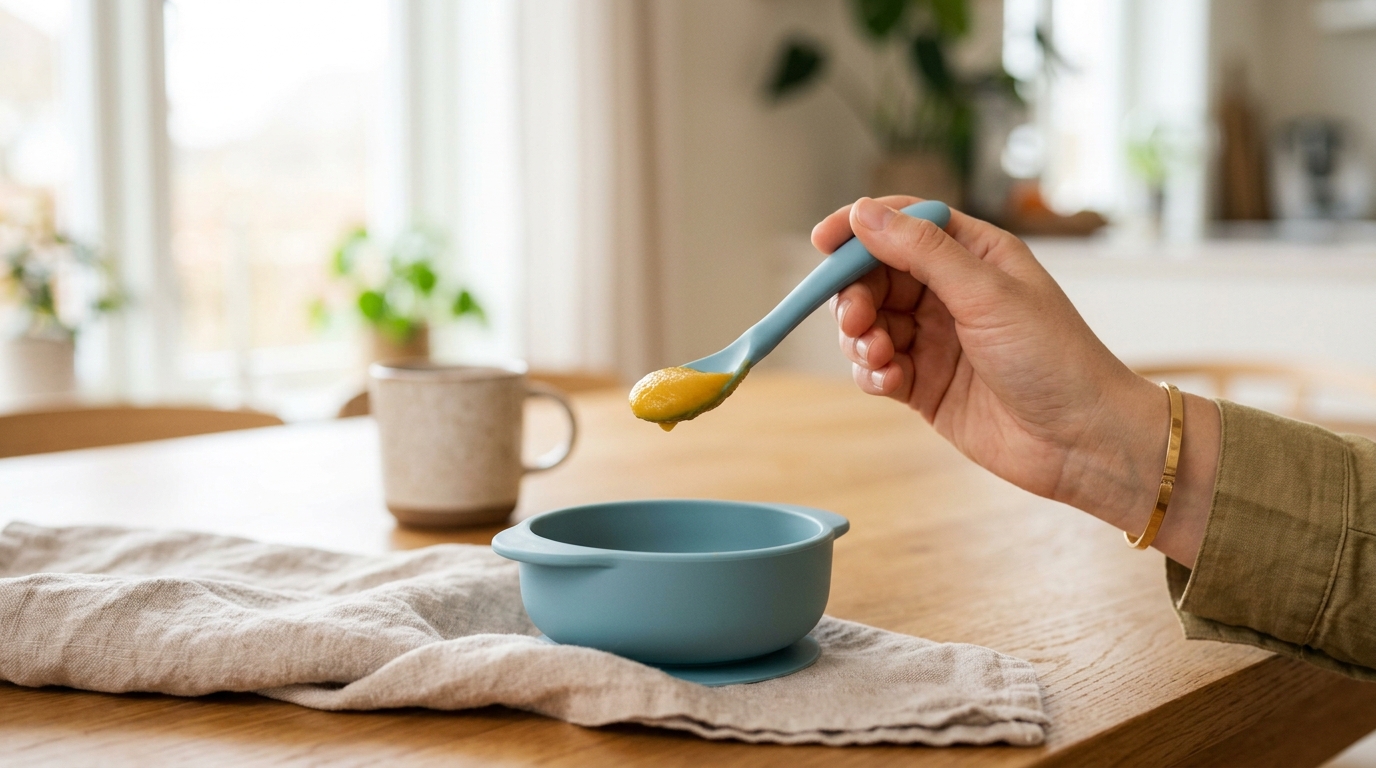
| First food | Why it’s a good start | How to serve it at about 6 months |
|---|---|---|
| Iron-fortified infant cereal (oatmeal, barley) | Easy iron source, easy to thin | Mix with breast milk or formula to a runny consistency |
| Pureed meat or poultry | Iron and zinc | Cook until very tender, blend with water or milk until smooth |
| Mashed beans or lentils | Plant-based iron and protein | Cook until soft, mash or blend, thin if needed |
| Mashed egg yolk or well-cooked whole egg | Iron, protein, and an early allergen | Hard-boil or scramble fully, mash fine |
| Avocado or banana | Soft, no cooking, a good first try | Mash with a fork until smooth |
| Sweet potato, squash, carrot | Mild, naturally sweet, easy to puree | Steam or roast until very soft, then mash or blend |
| Pear, peach, apple | Gentle fruit for variety | Cook until soft and puree, no raw hard pieces |
How fast to add new foods. The AAP says to give single-ingredient foods and wait about 3 to 5 days between them, so you can spot a reaction. Once a few foods are going well, you can combine them. Pairing something new with something your baby already likes helps with acceptance.
No honey before age 1, because of botulism risk. No added salt or sugar. No cow’s milk as a drink before age 1, though yogurt and cheese are fine as foods. No cereal in the bottle.
When and how to introduce allergens
This is the part that makes new parents the most nervous, and the evidence has changed the most. The AAP says there’s no evidence that delaying common allergens like egg, dairy, or peanut past 4 to 6 months helps, and the major studies point the other way. The LEAP trial found early peanut introduction cut peanut allergy risk by 81% in high-risk infants, and the EAT study found babies given six allergens early had 67% fewer food allergies by age 3 (Allergy & Asthma Network).
The nine foods to work in are peanut, egg, cow’s milk (as yogurt or cheese), tree nuts, soy, wheat, fish, shellfish, and sesame. A few practical rules from the Allergy & Asthma Network and Solid Starts:
- Add one allergen at a time, early in the day, so you can watch your baby for at least 2 hours.
- Serve them safely. Thin smooth peanut butter or tahini with water, breast milk, or formula until runny. Never give whole nuts or a spoonful of thick nut butter. Cook egg and fish fully and mash or flake them.
- Keep it going. Once an allergen is safely in, serve it about 2 to 3 times a week so the exposure sticks.
- Know the warning signs. Hives, swelling, or vomiting means stop that food and call your pediatrician. Trouble breathing or swelling of the face or lips is a 911 situation.
If your baby has severe eczema or a known food allergy, talk to your pediatrician or an allergist before trying peanut or egg at home. Some of these babies are advised to start as early as 4 months, sometimes after testing. Guidance on spacing differs a little between sources, with some saying 2 to 3 days between new allergens and the AAP saying 3 to 5 days between new foods, so follow your own pediatrician’s schedule.
Make allergen introduction easier
We reviewed the kits built to take the guesswork out of early allergen introduction, and the at-home tests that sometimes come up alongside them.
See the allergen kit roundup → See the allergy test kit guide →Do you need a special appliance?
No. A baby food maker is a convenience, not a requirement. Even a company that sells them concedes specialized equipment isn’t mandatory, and says the choice comes down to your habits (Grownsy, a baby food maker seller, so read its pitch with that in mind). What you need is a way to cook food until it’s very soft and a way to get it smooth. Any of these work:
| Tool | Best for | Trade-off |
|---|---|---|
| Fork or potato masher | Banana, avocado, beans, sweet potato, egg | Not smooth enough for fibrous foods or meat, but fine from about 7 months for lumpier textures |
| Blender or food processor you already own | Meat, leafy greens, big batches to freeze | More parts to wash, and small amounts can get stuck under the blade |
| Immersion (stick) blender | Small batches right in the pot | Cheap and easy to rinse, but you need a deep container |
| Baby food maker (steam and blend) | Small daily batches, fewer dishes | An extra purchase, and small capacity |
| Baby food mill (hand-cranked) | Smooth purees without electricity, travel | Takes elbow grease, struggles with meat |
If you’re buying nothing yet, start with a fork and what’s in your kitchen. Add a blender-type tool only once you know you’ll make purees regularly. And you don’t strictly need purees at all. Some families skip them and offer soft finger-size pieces (baby-led weaning), while others spoon-feed, and many do both. Either is fine as long as foods are soft, age-appropriate, and offered with your baby sitting upright.
Prep tools worth buying
The food maker picks come from independent testing by Reviewed and Forbes Vetted.
Best overall in both tests. Reviewed found its purees consistently smooth and quiet to run.
Check price on Amazon →Best value at Reviewed, with storage containers and a freezer tray included. One catch: food can stick under the blades.
Check price on Amazon →Forbes picked it as the easiest to use, with an automatic steam-and-blend cycle of about 10 minutes.
Check price on Amazon →An immersion blender. Reviewed found it made a smooth spinach puree in 30 seconds where two of the top three machines failed.
Forbes’ best food mill, a portable manual option that needs no outlet.
Check price on Amazon →Feeding essentials
Portion once, then thaw one cube at a time.
Check price on Amazon →Gentle on gums and small enough for tiny first bites.
Check price on Amazon →First meals are messy, and these wipe clean.
Check price on Amazon →Should you track what your baby has tried?
Yes, and it takes a minute a day. Waiting 3 to 5 days between new foods only works if you can remember what was new three days ago, and a reaction is much easier to sort out when you have a written record. It also helps when you’re running the allergen schedule (which ones are in, and when they last got served), and it gives your pediatrician a clear answer at the next checkup.
A notes app, a spreadsheet, or the back of a receipt on the fridge all work. Log these things:
| Date | New food | How it was served | Reaction or notes | Allergen? (last served) |
|---|---|---|---|---|
| Oct 1 | Iron-fortified oatmeal | Thinned with formula, 2 spoonfuls | None. Made a face, then wanted more | No |
| Oct 4 | Mashed avocado | Plain, fork-mashed | None. Loved it | No |
| Oct 7 | Peanut (thinned smooth peanut butter) | 2 tsp, mixed in oatmeal, morning | Watched 2 hours: none | Yes, peanut (Oct 7) |
Two habits make it more useful. First, mark each allergen once it’s been safely tried, then note the last date you served it so you can keep it up 2 to 3 times a week. Second, record the reaction column even when it’s “none,” since a blank is ambiguous later.
Gagging, choking, and keeping mealtimes safe
Gagging looks alarming and is normal. It’s a protective reflex that pushes food forward, and it usually comes with coughing, gurgling, or a bit of spit-up. Give your baby a moment to work through it, and resist the urge to scoop food out with a finger, which can push it farther back (Children’s Wisconsin).
| Gagging (normal) | Choking (emergency) | |
|---|---|---|
| Sound | Coughing, sputtering, gurgling | A high-pitched sound, or no sound at all |
| Breathing | Baby is still moving air and may spit up | Airway is blocked: baby can’t cry, cough, or breathe |
| What you do | Stay calm, give a moment, don’t reach in with a finger | Back blows alternating with chest thrusts, call 911, start CPR if baby goes limp |
Seat your baby fully upright in a high chair, never reclined, in a car seat, or while walking. Stay within arm’s reach for the whole meal. Avoid whole nuts, whole grapes, hot dogs, raw hard vegetables, popcorn, and hard candy, and cut or mash anything round or firm. Offer small amounts and let your baby set the pace. And take an infant CPR and first-aid class before the first bite if you can. It’s worth the two hours.
The Bottom Line
Start when your pediatrician says your baby is ready. Offer smooth, iron-rich, single-ingredient foods in tiny amounts, add something new every few days, and work the common allergens in early and keep them going. You don’t need a gadget to begin, just a fork, a pot, and a blender if you have one, and a simple written log will save you a lot of second-guessing.
This article is general information, not medical advice. Always follow your pediatrician’s guidance for your baby.
Starting Solids FAQ
Do I need a baby food maker to start solids?
No. A fork, a pot, and a blender you already own are enough to begin. A dedicated maker saves cleanup if you plan to make small fresh batches every day.
How much should a 6-month-old eat when starting solids?
Very little. The AAP suggests half a spoonful or less at first, offered alongside breast milk or formula, which is still the main source of nutrition.
How often can I introduce a new food?
The AAP suggests single-ingredient foods with about 3 to 5 days between new ones, so you can spot a reaction. Your pediatrician may give you a different schedule, especially for allergens.
Can a 6-month-old have peanut butter?
Yes, in the right form. Thin smooth peanut butter with water, breast milk, or formula until runny, and never give whole nuts or thick spoonfuls. If your baby has severe eczema or a known food allergy, talk to your pediatrician first.
What if my baby gags or pushes the food out?
Both are common at the start. Pushing food out with the tongue is a normal early reflex rather than a refusal, and gagging is a protective reflex that is different from choking (see the safety section above).
Can babies have honey or cow’s milk?
Not before age 1 for honey, because of botulism risk, and not cow’s milk as a drink. Yogurt and cheese are fine as foods.
Our Starting Solids Toolkit
- Beaba Babycook Solo — steam and blend in one machine
- NutriBullet Baby Steam + Blend — a budget steam-and-blend option
- Silicone freezer trays — portion once, thaw one cube at a time
- Allergen introduction kits — our full roundup
Sources: AAP, HealthyChildren.org · Allergy & Asthma Network · Solid Starts · Seattle Children’s · Children’s Wisconsin · Reviewed · Forbes Vetted